How to Know When It’s Time for a New Scheduling and Capacity Planning Tool


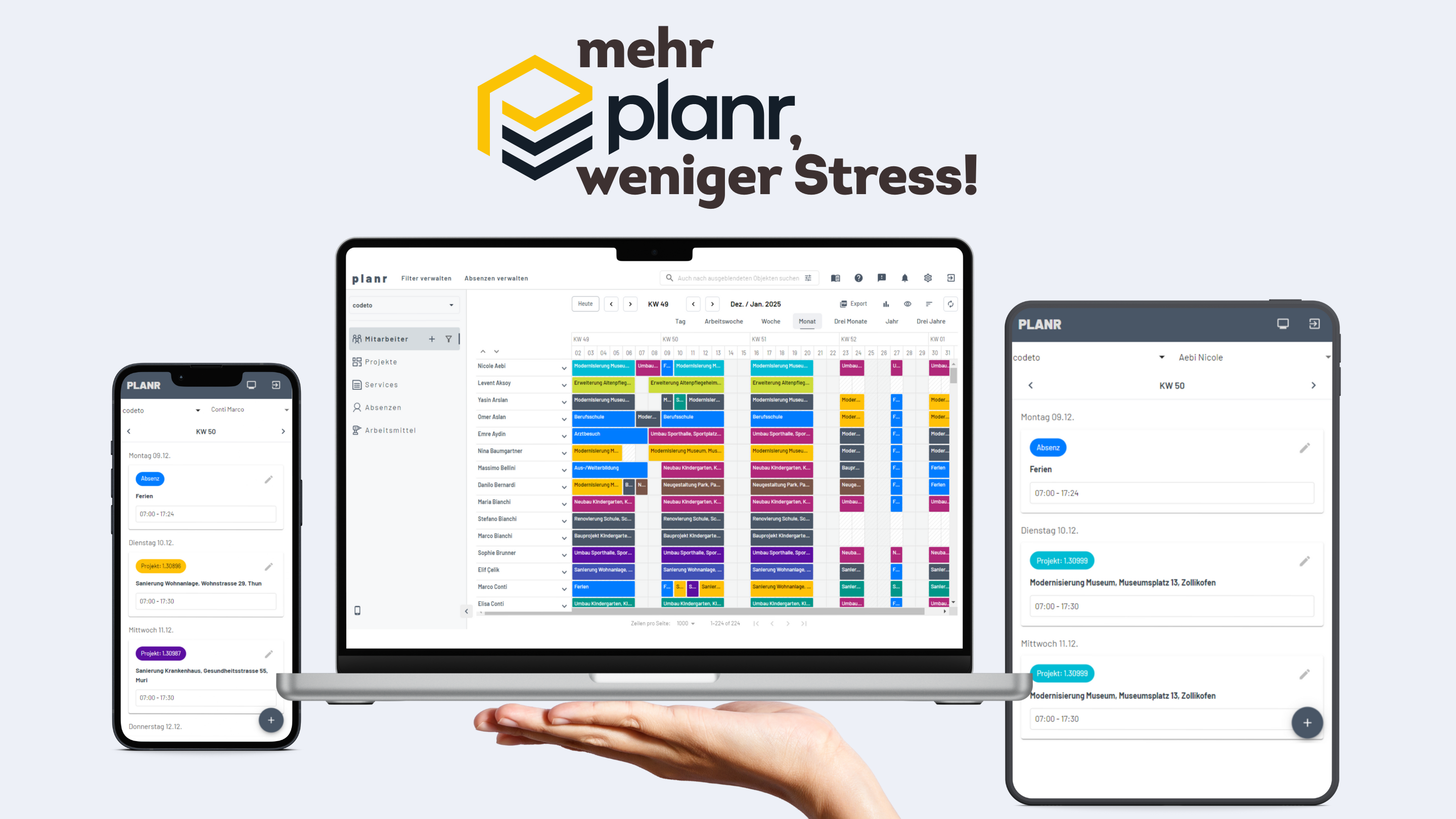
In many companies in the construction and related trades, it quickly becomes clear in day to day work how important reliable scheduling and capacity planning is. Over time, processes and tools evolve, and eventually a point is reached where the existing setup no longer works smoothly. This was exactly the situation for one of our customers, who openly described why moving to a central planning tool became necessary and how they evaluate success today.
1. When do you know it’s time for a new planning tool?
Lack of visibility across the team
Many companies still rely on Excel sheets, Outlook calendars or informal coordination. This leads to fragmented information and uncertainty in daily operations. In the customer’s case, other teams often had no visibility into how staff were scheduled, which made planning across areas difficult.
Multiple tools make coordination harder
When several systems are used in parallel, planning becomes more complicated. Information is stored in different places, updates take longer, and short notice adjustments are difficult. This challenge becomes even bigger when staff need to be assigned flexibly across different areas or locations.
Growing need for transparency
As companies grow or introduce new systems, the need for a shared, centralised planning view increases. For this customer, the introduction of a new time tracking system highlighted the need for a unified planning process.
2. Setting clear goals before introducing a new tool
The value of a new tool becomes much clearer when goals are defined upfront. The customer used simple, practical criteria.
Increasing transparency
A key goal was enabling management to access an up to date overview of all assignments at any time, without having to gather information from different documents or calendars.
Understanding actual tool usage
The customer tracks how many employees per team are actively scheduled. This usage rate shows whether planr is being adopted in day to day work and whether the new process is functioning as intended.
Qualitative improvements
In addition to measurable factors, qualitative improvements were defined as important indicators:
- clearer processes
- faster response times
- fewer coordination steps between teams
- more transparency in day to day work
These indicators usually become visible after a few weeks of regular use.
3. How to measure the success of the implementation
To make the transition measurable, the customer focuses on a few clear points.
Usage rate
The number of employees actively scheduled per team or area shows how well planr is integrated into daily routines. An increasing usage rate indicates successful adoption.
Improved visibility of capacity
With centralised planning, companies gain a clearer picture of available and assigned capacity. This helps identify bottlenecks and areas with unused potential.
Transparency without additional coordination
Another indicator is how quickly an up to date overview can be retrieved. If teams and management can access relevant information without follow up questions, a key goal of the implementation has been achieved.
Conclusion: When does a new planning tool make sense?
A new scheduling and capacity planning tool becomes valuable especially when:
- there is limited visibility into assignments and capacity, regardless of company size
- existing tools like Excel or Outlook become too time consuming
- transparency and traceability need to improve
- the organisation wants to understand how actively planning is being used
- capacity information should be centralised and easier to access
- workflows need to become simpler and more consistent, whether for a small team or across multiple areas
Experience from practice shows that with clear goals and a few straightforward indicators, the success of an implementation becomes easy to assess. At the same time, a planning foundation emerges that is transparent, flexible and reliable.
The future of planning starts here - are you in?
Contact us
Contact us for a free consultation, a demo, or general inquiries. We respond within 24 hours and look forward to hearing from you.